Beyond the Bottle
WRITTEN BY AUDREY HAN
ILLUSTRATED BY DIANA FENG
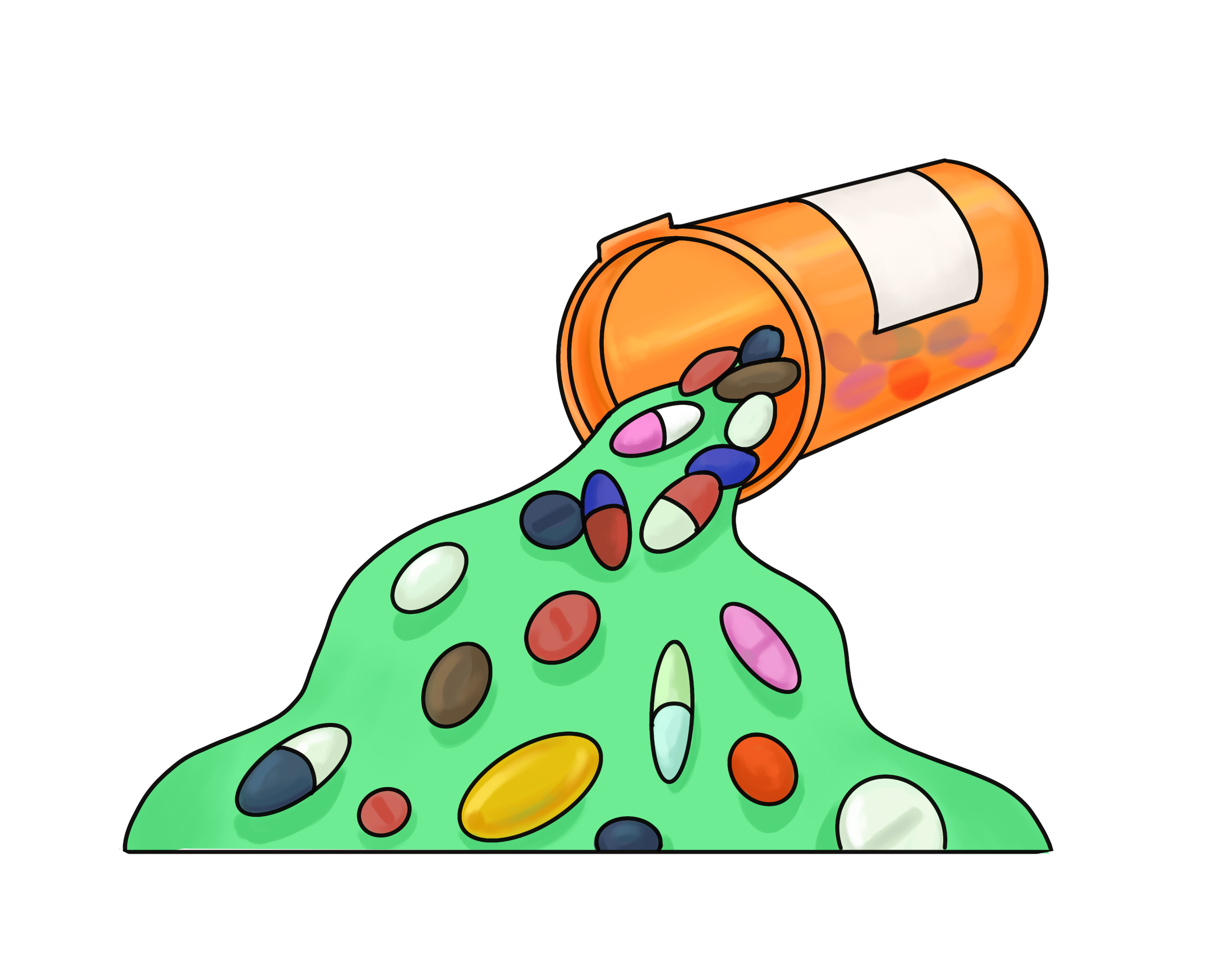
Medication is, in my opinion, one of the most remarkable discoveries in human history. It saves lives, provides comfort to families, and gives countless people the chance to live with purpose and possibility. As amazing of a miracle pharmaceuticals are, waste disposal practices for medications have historically been inadequate. Medications are often disposed of incorrectly in ways that are environmentally harmful. Different types of medication pose different environmental risks. For example, antibiotics contribute to antibiotic resistance in environmental bacteria, hormones can disrupt endocrine systems in wildlife, and cytotoxic drugs can harm non-aquatic creatures. Not only that, those iconic amber vials contribute to plastic waste and long term environmental pollution. As such, both producers and consumers share responsibilities in ensuring safe, sustainable, and accountable disposal methods, pushing us to rethink how prescribed medication disposal can be adapted to reduce its environmental consequences.
Modern-day manufactured medication is more often than not made in laboratories using synthetic ingredients.1 This is done through chemical synthesis, purification, and formulation. Because pharmaceutical drugs are designed to remain biologically active, they may not break down easily in natural environments, allowing them to persist in ecosystems for long periods of time. As such, proper disposal practices are essential to protect our planet. Factors like the type of medication, duration of prescription, and patient’s medical condition heavily influence whether or not a patient finishes their prescribed medication. Even so, the overall percentage of patients that do so sits at around 50%.
It is also important to note the type of medication, as different medications have similar yet varying environmental impacts. The environmental impact of medications is influenced not only by how they are used and how they are exposed, but also by their type, potency, and method of production. Let’s start by looking at radioactive. Radioactive decay refers to the natural process where radioactive isotopes lose energy by emitting radiation over time until they become more stable. Because of this, radioactive medical waste is typically stored for a few days to allow for sufficient time to decay before disposed of. If radioactive medications are not properly decayed, they can release radiation into wastewater, exposing nearby organisms and people to radiation. Unlike standard non-radioactive medication, radioactive medication waste is shorter-lived but more intense and causes more localized environmental risks.2. Herbal medications can also pose environmental risks, especially when demand leads to overharvesting of wild plants for medicine. Overharvesting can threaten biodiversity, while large scale cultivation of herbs may contribute to soil and water pollution. Some plant compounds can even affect aquatic life. Speciality medications like biologics, gene therapies, and targeted cancer therapies require much more complex manufacturing than the other listed medications. As a result, they’re much more structurally complex, which can make them resistant to natural degradation processes in the environment. As such, even small amounts of leftover drug can affect ecosystems if improperly disposed of.3
Producers and consumers both have responsibilities in proper pharmaceutical waste management. Producer waste from pharmaceutical industries and manufacturers is often generated during the production and formulation of medications. These types of waste include chemical residues from synthesis and purification, contaminated water or byproducts from drug manufacturing, and expired or defective batches of drugs. Current procedures on producer waste are tightly regulated by environmental and hazardous waste laws, particularly the Resource Conservation and Recovery Act, a federal law governing the disposal of solid and hazardous waste. Consequently, many companies treat waste on-site or pay for specialized disposal. However, the waste still poses high toxicity after short-term exposure if untreated, creating significant risks to both human and environmental health. Potential solutions to preventing waste from producers include industrial waste treatment and green chemistry.4 For example, advanced oxidation processes use strong oxidants to break down pharmaceutical molecules into less harmful compounds, while green chemistry approaches aim to design safer chemicals that degrade easily in the environment after use.
Meanwhile, consumer waste from households, patients, and healthcare facilities comes after the medication has entered the market and reached patients. The improper disposal of unused or expired medications is the primary source of consumer waste, which is widespread but lower in concentration than producers. Although lower in concentration, this does not change the fact that it is a major contributor to environmental contamination. Pharmaceutical waste can enter sewage systems through improper disposal, such as flushing unused medications, and through human excretion, as many drugs are not fully metabolized as they travel through the body, leaving traces of active compounds released in feces or urine.5 This can lead to active pharmaceutical ingredients entering landfills or wastewater, contaminating soil and water supplies where they typically persist in ecosystems for long periods of time and cause harmful effects in wildlife. Additionally, consumer waste is harder to regulate because it depends heavily on the individual behavior of consumers.6
Potential solutions to reducing consumer waste include implementing drug take-back programs increasing public education on the proper disposal of medications. Drug take-back programs allow people to safely return unused, unwanted, or expired medications at designated collection sites like pharmacies or hospitals. These programs are supported by government agencies or healthcare organizations to ensure safe and proper disposal of medications. For instance, the Drug Enforcement Administration (DEA) organizes National Take Back Day events throughout the year and have successfully collected thousands of unused medications. Public awareness drives these initiatives. Educating consumers about the importance of proper disposal methods can increase participation in said take-back programs. Ultimately, consumers play a vital role in minimizing pharmaceutical waste, and by being aware of proper disposal methods, each individual can contribute to protecting the environment and public health.
Now, you can argue that individual efforts to properly dispose of pharmaceutical waste are insignificant, much like how many people feel that their personal actions to reduce carbon emissions are too small to affect climate change. However, just as climate action relies on the collective social and political impact of individual choices, responsible management of pharmaceutical waste can drive broader environmental benefits when communities, healthcare systems, and policymakers act together.7 Even though pharmaceutical waste may be smaller in scale than other forms of pollution, its impacts on water systems, wildlife, and human health are significant and preventable.8
This issue is especially important when considering climate justice and the unequal impacts of pollution. Marginalized communities are more likely to live near waters contaminated by medical chemicals and are less likely to have access to advanced water treatment systems. On top of that, these communities typically have fewer resources, making them more vulnerable to the harmful effects of pollutants. It is also important to consider that pharmaceutical waste chemicals spread far beyond their point of disposal, creating a wide radius of influence that affects everyone; one we all must take action to address.With this in mind, proper disposal of medication becomes more than simply an environmental issue, branching into public health and social equity. As such, solutions should extend beyond individual responsibility to systemic change. This doesn’t require massive changes, such as integrating strider regulations on healthcare facilities, right from the start. Even small actions like using take-back programs or following disposal guidelines can demonstrate that responsible behavior at the individual level is an important part of a larger solution.7 It’s not an everyday task to dispose of medications, but being mindful each time you do so can make a meaningful difference. The next time you dispose of medication, choose to do it responsibly. Your decision has the power to protect your community’s health, reduce environmental harm, and help drive the larger change needed to minimize pharmaceutical waste.
References
- Newman, D. J.; Cragg, G. M. Natural Products as Sources of New Drugs from 1981 to 2014. J. Nat. Prod. 2016, 79 (3), 629–661. https://doi.org/10.1021/acs.jnatprod.5b01055.
- Mohamadi Baghmolaei, Z.; Fardid, R.; Haghani, M.; Haddadi, G.; Abdolahi, M.; Ghaderian, M. Evaluating the Radioactive Waste Produced per Patient by Radiopharmaceutical Sources and Measuring the Radioactive Contamination of Surfaces and Staff at the Bushehr Nuclear Medicine Department. J Biomed Phys Eng 2024, 14 (3), 245–254. https://doi.org/10.31661/jbpe.v0i0.2209-1535.
- Liu, F. The Science and Practice of Current Environmental Risk Assessment for Gene Therapy: A Review. Cytotherapy 2024, 26 (7), 686–699. https://doi.org/10.1016/j.jcyt.2024.04.067.
- US EPA, O. The Impact of Pharmaceuticals Released to the Environment. https://www.epa.gov/household-medication-disposal/impact-pharmaceuticals-released-environment (accessed 2026-03-03).
- Insani, W. N.; Qonita, N. A.; Jannah, S. S.; Nuraliyah, N. M.; Supadmi, W.; Gatera, V. A.; Alfian, S. D.; Abdulah, R. Improper Disposal Practice of Unused and Expired Pharmaceutical Products in Indonesian Households. Heliyon 2020, 6 (7), e04551. https://doi.org/10.1016/j.heliyon.2020.e04551.
- Rogowska, J.; Zimmermann, A. Household Pharmaceutical Waste Disposal as a Global Problem—A Review. International Journal of Environmental Research and Public Health 2022, 19 (23), 15798. https://doi.org/10.3390/ijerph192315798.
- National Academies of Sciences, E.; Studies, D. on E. and L.; Technology, B. on C. S. and; Manufacturing, C. to I. I. T. to A. P. Innovations in Manufacturing Drug Substances. In Innovations in Pharmaceutical Manufacturing on the Horizon: Technical Challenges, Regulatory Issues, and Recommendations; National Academies Press (US), 2021.
- A 10-Step Blueprint for a 10-Step Blueprint for Managing Pharmaceutical Waste in Managing Pharmaceutical Waste in US Healthcare Facilities US Healthcare Facilities 2022 Edition 2022 Edition 2. https://www.epa.gov/system/files/documents/2022-10/10_step_blueprint_guide_final_9-22.pdf.
- Chen, S.-L.; Yu, H.; Luo, H.-M.; Wu, Q.; Li, C.-F.; Steinmetz, A. Conservation and Sustainable Use of Medicinal Plants: Problems, Progress, and Prospects. Chin Med 2016, 11 (1), 37. https://doi.org/10.1186/s13020-016-0108-7.
- Buszka, P. M.; Yeskis, D. J.; Kolpin, D. W.; Furlong, E. T.; Zaugg, S. D.; Meyer, M. T. Waste-Indicator and Pharmaceutical Compounds in Landfill-Leachate-Affected Ground Water near Elkhart, Indiana, 2000–2002. Bull Environ Contam Toxicol 2009, 82 (6), 653–659. https://doi.org/10.1007/s00128-009-9702-z.
- Is Your Carbon Footprint BS? – How to Save a Planet | Podcast on Spotify. Spotify. https://open.spotify.com/episode/0SyiN9n3KsMV3SYT9UG7N5 (accessed 2026-03-03).
- Karim-Nejad, L.; Pangilinan, K. How Should Responsibility for Proper Medication Disposal Be Shared? AMA Journal of Ethics 2022, 24 (10), 971–979. https://doi.org/10.1001/amajethics.2022.971.