
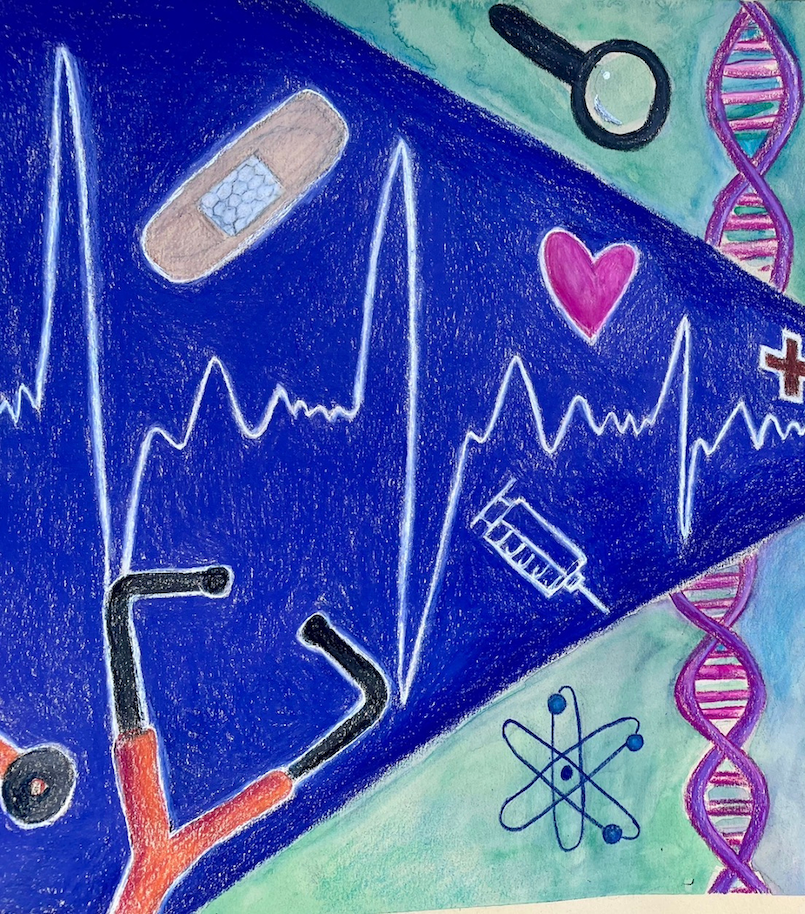
AI Can Diagnose You, But Should it Replace Doctors?
WRITTEN BY DINA EMIL
ILLUSTRATED BY CASSANDRA CHANG
A patient sits in an exam room, waiting for a diagnosis. Instead of a physician entering with a clipboard, an algorithm analyzes symptoms, lab results, imaging data, and delivers a likely diagnosis within seconds. This scenario is no longer science fiction. As AI becomes more accessible, it is safe to say that machine learning algorithms are increasingly influencing clinical decision making across a wide range of medical settings. Artificial Intelligence is already being used to read radiology scans, predict disease progression, and flag high-risk patients faster than doctors can. As these tools grow more accurate, the question emerges: if AI can diagnose patients, should it replace doctors?
It is understandable that some may face concern when picturing what the effects of AI may look like in the future. With its ability to create code in seconds, identify images, and even create media such as videos and art, it is no doubt that some professions may be vulnerable to a bot being able to master skills much quicker than any professional can. However, this amplified anxiety fails to remind us that despite rapid advancements, AI systems remain imperfect and can still produce significant errors. Therefore it still reinforces the need for human supervision rather than full professional replacement. While artificial intelligence is certainly efficient and precise, having it replace physicians would certainly overlook the most essential components in medicine: human connection, ethical responsibility, and clinical judgement. While we may not see the replacement of doctors in the future of medicine, we are likely to see a future in which the advantages of AI reshape how they practice.
One of AI’s greatest strengths lies in pattern recognition. Often defined as machine learning, AI systems improve through repeated use by identifying patterns in stored data, allowing them to generate more accurate results in increasingly shorter time frames. In relevance to medicine, machine learning models can be trained on millions of medical images or patient records, allowing them to detect subtle abnormalities that even experienced clinicians might overlook. For example, AI systems extract numerous radiographic features such as tumor shape, which are then filtered to retain only the most clinically relevant data. These selected features are used to train statistical AI models capable of identifying imaging-based biomarkers associated with disease.1
Speed is another advantage of AI in medical settings. In fast-paced clinical environments, time is often critical. An AI system’s ability to develop results instantaneously enables earlier intervention if needed. In emergency settings, where minutes can change outcomes, such efficiency can save lives. In addition, machines are able to standardize care and reduce variability of human error among clinicians, ensuring that critical signs are consistently flagged. Perhaps a simple answer was all a patient needed, using AI to self-diagnose can help them avoid a doctor’s appointment overall, which is appealing to those who have less access to healthcare.
Despite these benefits, diagnostic accuracy alone does not make AI fully reliable on its own. Medical decision-making is rarely based on data isolation. Patients present complex medical histories, often with overlapping symptoms and personal circumstances that cannot be quantified, and require contextual understanding. Machine learning relies entirely on pattern recognition and the data they are trained on. When that data is incomplete or biased, the resulting conclusions may be flawed.
Beyond issues on accuracy, concerns about algorithmic bias also remain prevalent. Because machine learning models are trained on historical datasets, they may inadvertently emphasize existing healthcare disparities, particularly among underrepresented patients. An algorithm may identify a statistically optimal course of action, but it cannot weigh ethical considerations, patient preferences, or the emotional impact of a diagnosis. Medicine requires judgment under uncertainty, a skill that extends beyond pattern recognition.2 This risk amplifies ethical concerns and the importance of human oversight in the use of AI.
Most importantly, medicine is a human practice. Delivering a diagnosis may often involve life-altering decisions, and can affect the patients vulnerably. Physicians do more than just identify a disease. As healthcare workers, they are expected to provide reassurance and help patients navigate difficult choices. Such responsibilities require emotional support that machines cannot provide.
The question, then, is not whether AI should be a replacement for our hardworking physicians, but how it can be used to improve care without compromising the ethical foundations of medicine. Even with promising advancements, many stakeholders remain hesitant about incorporating artificial intelligence in medical decision-making. A common concern is that integration of AI in professional fields may weaken human intelligence. However, this argument overlooks the fact that effective integration requires rigorous evaluation by humans, and constant development to meet our expectations in the workfield. Physicians must also be educated to understand AI’s capabilities and limitations, ensuring they remain critical decision-makers rather than passive recipients of algorithmic output.3
This is not to suggest that AI’s role in healthcare will not continue to expand. Embracing its strengths while acknowledging its limitations is the best path we can take to efficient healthcare. Diagnosis is not merely a computational task, but rather a deeply human process. For this reason, artificial intelligence should not be viewed as a substitute for physicians, but as a powerful tool that can be carefully integrated to enhance humanity as the center of patient care.
References
- Hosny, A.; Parmar, C.; Quackenbush, J.; Schwartz, L. H.; Aerts, H. J. W. L. Artificial Intelligence in Radiology. Nature Reviews Cancer 2018, 18 (8), 500–510. https://doi.org/10.1038/s41568-018-0016-5.
- Ferrario, A.; Gloeckler, S.; Biller-Andorno, N. Ethics of the Algorithmic Prediction of Goal of Care Preferences: From Theory to Practice. Journal of Medical Ethics 2022, medethics-2022-108371. https://doi.org/10.1136/jme-2022-108371.
- James, T. How Artificial Intelligence is Disrupting Medicine and What it Means for Physicians | Harvard Medical School Professional, Corporate, and Continuing Education. Harvard.edu. https://learn.hms.harvard.edu/insights/all-insights/how-artificial-intelligence-disrupting-medicine-and-what-it-means-physicians.